The New Baseline for Candidate Experience
Treating candidates with respect is no longer optional. Modeled after rigorous cybersecurity and operational compliance standards, the FHA provides a strict, auditable set of controls to eliminate bias, protect candidate data, and ensure process integrity.
Organizations demand exhaustive qualifications and strict diligence from applicants, yet often run their hiring pipelines as black boxes. Accountability is bidirectional. If you expect top-tier candidates to check every box in a rigorous interview process, your organization must be willing to submit to the same level of auditable compliance.
Recruiters and top-tier candidates are now demanding organizational adherence to FHA standards before engaging in the hiring lifecycle.
- Published standard: FHA v1.0.0
- Eliminates subjective, gut-feeling evaluations.
- Enforces definitive candidate disposition and communication SLAs.
Official Compliance Mandate
Organizations claiming FHA compliance must undergo continuous internal audits and objective assessments against the 10 core domains defined in the framework template (Identifier: fhaf-audit).
Audit & Control Requirements
Compliance is verified through evidence-based procedures. For example, under Domain 10: Offer Parity & Final Evaluation, organizations must prove formula-driven offer generation to eliminate the negotiation penalty.
FH10.1.1: Standardized Compensation Calculation
Final offers are calculated using a matrix correlating scorecard results to published salary bands. Auditors will verify this by reconciling sample offers against candidates' objective rubric scores.
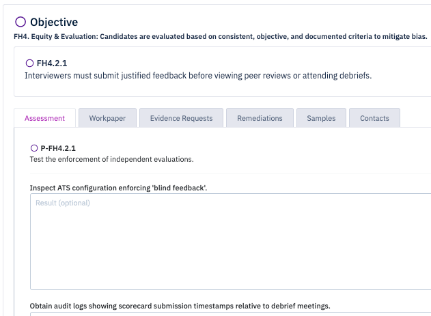
Furthermore, under Domain 4 (Equity & Evaluation), all interview questions must be directly mapped to the required skills of the role, representing a material failure (Kill Switch) if not adhered to.
The 10 Core Domains of FHA
Compliance requires strict adherence to all ten operational and ethical domains.
Governance
The organization establishes, oversees, and continuously evaluates its hiring policies to ensure alignment with fair, equitable, and transparent recruitment standards.
Transparency
The organization ensures information symmetry by proactively disclosing the hiring process, requirements, and compensation.
Candidate Experience
The organization operationalizes respect for the candidate's time through decisive communication, coordinated assessments, and professional preparedness.
Equity & Evaluation
Candidates are evaluated based on consistent, objective, and documented criteria to mitigate bias.
Time & Compensation
The organization respects personal time and IP by bounding evaluation length and compensating extensive work.
Communication
Active, two-way communication throughout the hiring lifecycle ensures candidates are never abandoned.
Integrity
The organization conducts hiring ethically, ensuring all published opportunities are legitimate and financially backed.
Data Privacy
Safeguard candidate personal data through strict access controls and explicit consent mechanisms.
Accessibility & Barrier Reduction
The organization actively removes logistical and socioeconomic barriers from the hiring process.
Offer Parity & Final Evaluation
Final offers and pre-employment screenings are governed by objective data and role relevance.
Demand Accountability
The industry standard for fairness has been established. It is the responsibility of candidates to ask if an employer is FHAF compliant, and the responsibility of organizations to prove it.